
Your Golf Cart's Batteries Died. Replace Them, or Buy a New Cart?
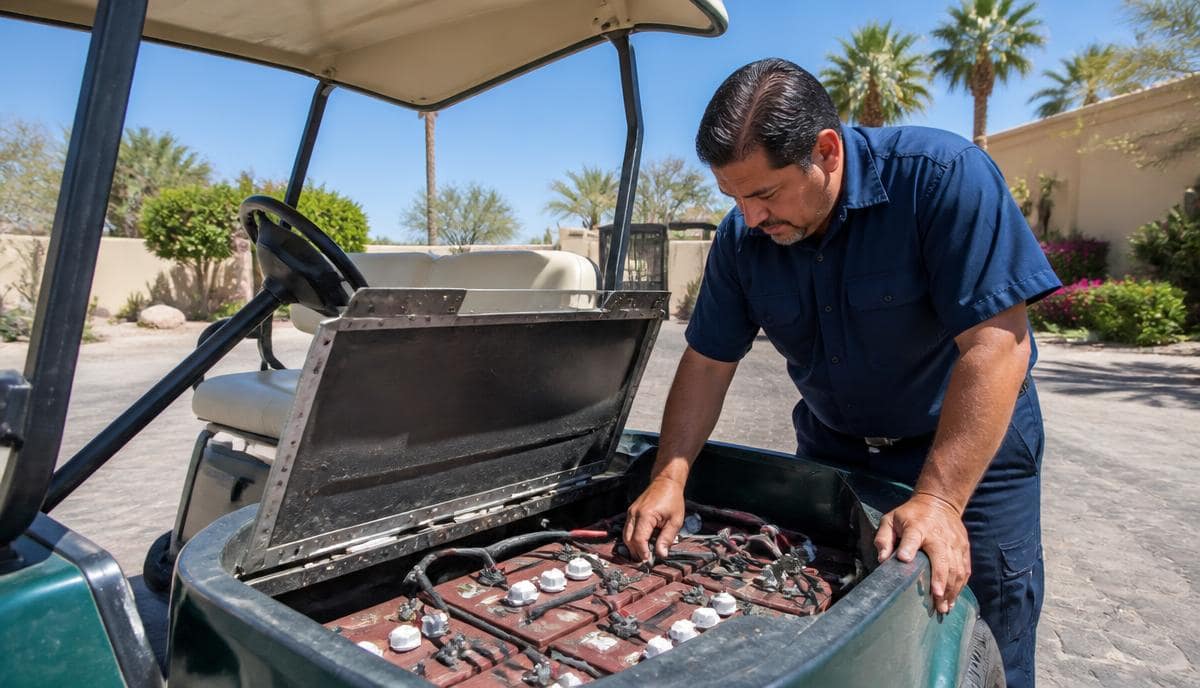
Let's get the obvious conflict of interest out of the way first: we sell new carts. We also sell and install battery packs. So we have no particular reason to push you one way, and we'd rather tell you the truth — which is that most carts with a dead pack are worth saving, and a minority are not.
The trick is knowing which one you have. It has almost nothing to do with the battery and almost everything to do with the cart around it.
The principle: batteries are a consumable, the cart is a platform
Nobody replaces a car because it needs tyres. Batteries in a golf cart occupy the same category — a wearing part with a known service life that gets renewed once or twice over the vehicle's life. Lead-acid packs in this climate have a short one. Lithium packs last considerably longer, which is most of the argument for them.
So the question is never really "are the batteries dead." It's: is the platform still good? A mechanically sound cart with a dead pack is a cheap fix. A tired cart with a dead pack is a money pit that happens to have a battery problem.
First: are the batteries actually dead?
Before spending anything, rule out the impostors. A significant share of the "my pack is finished" calls we get in Los Cabos turn out to be something else entirely:
- A corroded terminal or connection. Number one cause. Presents exactly like a dead pack.
- A failed charger or damaged charging port. The pack is fine; nothing is reaching it.
- One bad cell or one bad battery in a lead-acid string dragging the whole set down — sometimes replaceable individually.
- A BMS fault on a lithium pack, often triggered by sitting at the wrong state of charge through a Baja summer. Frequently recoverable.
- A cart simply stored badly while the owner was away, which is the single most common story behind an October service call.
A proper diagnostic answers this in one visit, and it's the cheapest money in this entire decision. Buying a pack you didn't need is a genuinely expensive mistake. Our service page explains how diagnostics work, and the fee is credited against whatever the fix turns out to be.
The platform check: five things that decide it
If the pack really is finished, here's what to assess. Note that only the first two actually tip the decision.
1. The frame — this is the one that matters in Baja
Salt air attacks welds, frame rails and the battery tray itself. Surface rust on a steel frame is normal and manageable. Structural corrosion is not, and it's not economically repairable. Get underneath, look at the welds, look at the battery tray, and push on anything that looks suspect.
This is the Baja-specific factor that catches people out. A cart of the same age in Arizona would be fine. Within a couple of kilometres of the ocean here, the frame can be finished while the rest of the cart looks presentable.
Frame gone? Buy new. Nothing else in this list overrides that.
2. Motor and controller
The three expensive parts on a golf cart are the pack, the controller and the motor. One of them failing is a repair. Two at once is a decision. Three is a new cart.
If your pack is dead and the motor is whining or the controller is throwing faults, you're no longer comparing a battery to a cart — you're comparing most of a cart to a cart.
3. Parts availability for your brand
This is the quiet one, and it's why we talk about it. A mechanically sound cart from a brand with no local parts support is worth less than the same cart from a supported brand, because every future repair carries a six-to-eight week international shipping wait.
If your cart came in privately from overseas and nobody in Baja stocks parts for it, factor that into the decision honestly. Putting a good new pack into a cart you can't get a controller for in high season is not a great investment.
4. Suspension, brakes, steering, body
These do not tip the decision. Bushings, shocks, tie rods, brake cables and worn seats are cheap and routine — the best-value repairs on a cart. Sun-faded paint and a tired canopy are cosmetic. Don't let a cart that merely feels worn out convince you it's finished; that feeling is usually a few hundred dollars of suspension work.
5. Whether the cart still fits your life
Sometimes the honest answer has nothing to do with condition. You bought a four-seater and now there are six of you. You're using it for a rental property and need something that looks newer. You've moved somewhere with hills.
That's a legitimate reason to change carts — just recognise it as a wants decision rather than a needs one. Our comparison of the E4, E6 and City covers what actually differs between sizes.
The upgrade worth considering: lead-acid to lithium
If you're running an older cart on lead-acid and the pack is done, this is the moment to think about converting rather than replacing like for like. It's frequently the best-value decision available to an older-cart owner in Baja, because it takes the single worst-suited component for this climate out of the vehicle.
What it changes for the better: no watering, dramatically longer service life, much lighter weight (which improves range and reduces strain on suspension), better performance late in the charge, and no acid corrosion in the battery tray.
What has to be checked before you commit:
- Charger compatibility. A lead-acid charger cannot correctly charge a lithium pack. Budget for the charger as part of the conversion, not a surprise afterwards.
- Controller and system voltage. Usually fine, but it must be confirmed for your specific cart.
- Battery tray dimensions and mounting. Lithium packs are physically different; the tray often needs adapting.
- Weight distribution. Removing a couple of hundred kilos of lead changes how the cart sits and rides. Usually an improvement, occasionally needs a suspension adjustment.
- BMS integration with the cart's existing wiring and gauges.
Done properly this can leave you with a cart that performs better than it did new. Done badly — a mismatched pack and charger, a bodged tray — it creates problems for years. It's not a DIY job.
What it does to resale
Worth knowing, because it changes the arithmetic: used carts hold their value well in Los Cabos, and a cart with a new, properly installed lithium pack and documentation for it sells quickly here. A cart with a dead or unknown pack sells slowly and cheaply, because every buyer assumes the worst and prices accordingly.
If you're thinking of selling within a couple of years, a new pack is not purely a cost — a meaningful share of it comes back at sale. If you're planning to keep the cart for a decade, ignore this entirely and just buy the better pack.
So: a simple way to decide
Work through it in this order:
- Diagnose first. Confirm the pack is genuinely the problem.
- Check the frame. Structural corrosion ends the conversation — buy new.
- Count the expensive failures. One is a repair. Two is a real decision. Three is a new cart.
- Check parts support for your brand locally.
- Compare honestly. Weigh the pack (plus charger, if converting to lithium) against what a new cart actually costs here, and factor in resale.
If the frame is sound, the motor and controller are healthy and parts are available, a new pack is almost always the better decision — you get most of a new cart's usable life for a fraction of a new cart's price.
Frequently asked questions
- Is it worth replacing the batteries in an old golf cart? Usually yes, provided the frame is structurally sound and the motor and controller are healthy. Batteries are a consumable; a good cart outlasts several packs.
- How do I know if my golf cart batteries are actually dead? You often don't without testing. Corroded connections, a failed charger, a damaged charging port, a single bad cell or a lithium BMS fault all mimic a dead pack. Diagnose before you buy.
- Can I put lithium batteries in an older golf cart? Usually, but it's a conversion rather than a swap. You'll need a lithium-appropriate charger, and the tray, mounting, controller compatibility and BMS integration all need checking first.
- What makes a golf cart not worth repairing? Structural frame corrosion, which is common near the ocean here and isn't economically repairable. After that: multiple expensive components failing at once, or a brand with no local parts support.
- Does a new battery pack increase what my cart is worth? In Los Cabos, yes — noticeably. A documented new lithium pack makes a used cart sell fast; an unknown pack makes buyers assume the worst.
- My cart feels worn out — isn't that a sign to replace it? Often that feeling is worn bushings, shocks and brakes, which are among the cheapest repairs on a cart. Get it assessed before you conclude it's finished.